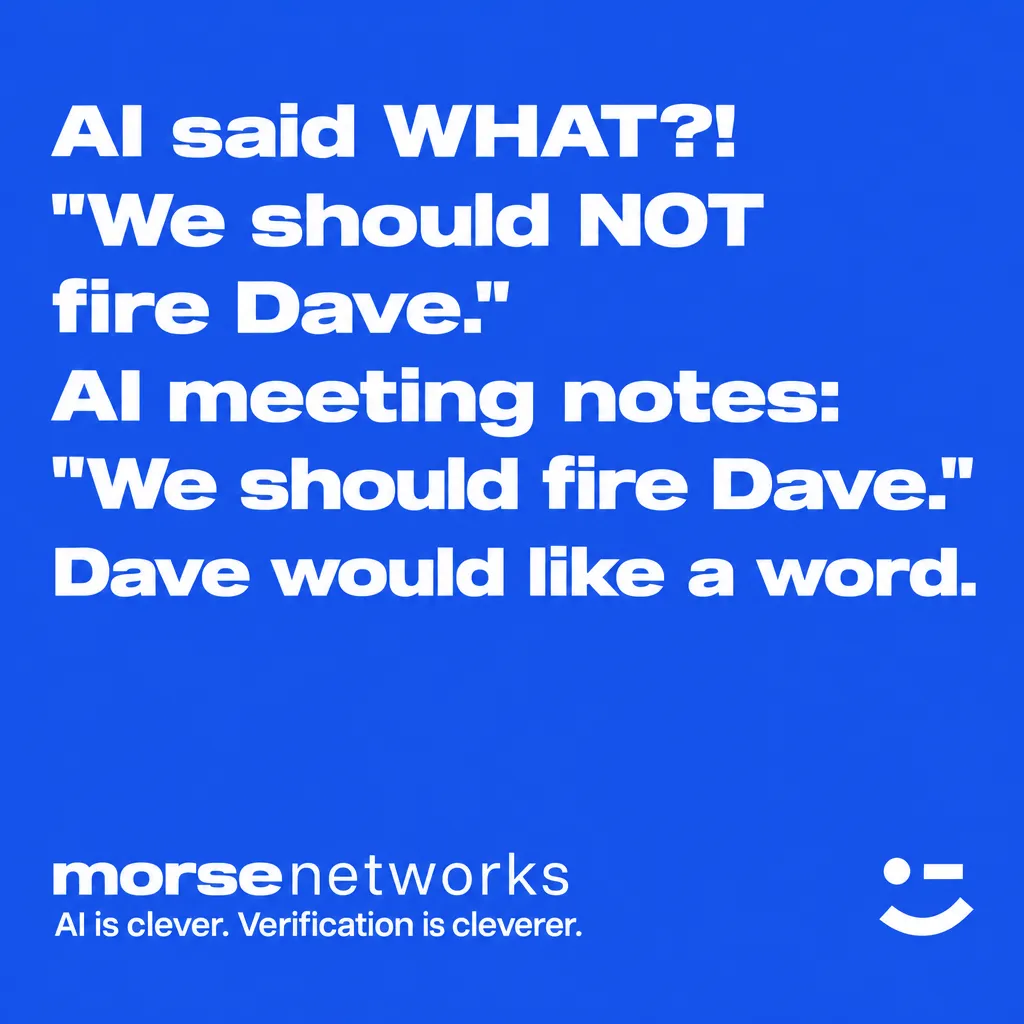

A missing “not” can make a meeting surprisingly expensive.
Your customer says they’re not approving the revised price. The automated notes say they are. Someone raises the order, and an ordinary Tuesday develops a legal subplot.
Speech tools put automated transcription on the agenda for businesses handling calls and meetings. The useful question is what happens between the software hearing a conversation and your team treating its output as fact.
For UK business owners, that needs a practical answer covering accuracy, privacy and responsibility.
Start with the words your business can’t afford to get wrong
A transcript can read beautifully while recording the wrong thing. Fluent text encourages confidence, including when confidence is entirely unearned.
Before adopting a transcription tool, test it against the conversations your team actually has. Include customer names, product codes and specialist terminology. Check prices and quantities particularly carefully.
“Fifteen” and “fifty” deserve attention. So do delivery dates, postcode references, accents and surnames that colleagues already spell out twice on the phone.
Use staged calls with invented customer details for initial testing. Include ordinary interruptions, poor microphones and people speaking over one another. A pristine demonstration recording tells you little about a Monday morning call from a noisy warehouse.
Keep a record of mistakes. You’re looking for patterns that could affect decisions, rather than awarding marks for punctuation.
Check the summary against the conversation
Transcription and summarisation introduce different opportunities for error. A transcript attempts to capture speech. A summary selects and interprets it.
That distinction matters especially when a tentative suggestion becomes an agreed action, or a customer’s objection disappears from the meeting notes.
Test both outputs separately. Check whether the transcript preserves conditions such as “subject to approval”. Then check whether the summary carries those conditions through.
Pay attention to who said what. A supplier proposing a deadline is different from your business accepting it. Speaker labels need checking too.
For important decisions, retain a way for authorised reviewers to consult the relevant source material, where appropriate under your retention policy. A polished paragraph shouldn’t be the only evidence available.
Give someone responsibility for the final record
Decide who reviews automated notes before they enter a customer record or trigger work.
For a routine internal meeting, the organiser may be the right person. For a price agreement, complaint or contractual discussion, someone with authority over that decision should confirm the relevant details.
Make the status visible. “AI-generated draft, awaiting review” is more useful than a document that looks approved because it has the company logo on it.
Set clear limits on automation. An unreviewed summary shouldn’t quietly authorise a refund, change bank details or confirm a commercial commitment.
If nobody owns the review, the software has effectively been promoted to decision maker. It hasn’t attended the induction.
Work out what happens to the audio
Call recordings and transcripts can contain personal data. They may also capture commercially sensitive information that nobody intended to distribute widely.
Before switching a tool on, map where the information goes. Establish which organisations process it, where it’s stored, and whether it moves outside the UK. Check any applicable international transfer arrangements.
Read the supplier’s terms for the specific product and account you’re buying. Establish whether recordings, transcripts or prompts can be used for model training, and what controls apply.
Check deletion arrangements, including backups and connected services. Deleting a transcript from one screen may leave copies elsewhere.
These answers should be documented. “It’s probably covered by our subscription” is a poor filing system.
Tell people what you’re doing
Recording or transcribing a conversation needs a proper data protection assessment. Work out your purpose and lawful basis, and explain the processing clearly to the people involved.
Consent isn’t automatically the right lawful basis for every business call. Equally, a brief recording announcement doesn’t settle every compliance question.
Your privacy information should reflect what actually happens, including relevant purposes, recipients and retention periods. Consider employees as well as customers, particularly where transcription could become a form of workplace monitoring.
Assess whether a data protection impact assessment is required. Take advice where conversations may include sensitive information or the proposed use carries greater risks.
Keep the explanation understandable. People should be able to tell why their conversation is being captured and how it will be used.
Limit access before connecting everything
A useful transcript can become an unnecessary disclosure when it lands in the wrong shared folder.
Check who can see recordings and notes by default. Restrict access according to people’s jobs, and review what happens when staff move roles or leave.
Pay particular attention to integrations. A transcription service might send notes to a CRM, email account or collaboration channel. Each destination creates another place to manage permissions and retention.
Avoid capturing more than the task needs. Some calls may need transcription paused or excluded altogether, depending on their content and your policies.
Check sharing links too. A confidential discussion deserves better protection than a URL forwarded with “thought you’d find this useful”.
Run a small pilot with clear stopping points
Start with a defined group and a limited use case. Routine internal project meetings may be a more manageable starting point than sensitive customer complaints.
Agree your acceptance criteria before the trial. Record critical errors, missed qualifications and incorrect speaker attribution. Measure review effort as well: notes that require extensive correction may offer little practical benefit.
Give staff a simple way to flag mistakes. Decide which failures mean pausing the pilot, changing settings or excluding a type of conversation.
Check the process again when you change models, languages or integrations. A successful trial applies to the setup you tested. It doesn’t approve every future configuration by association.
Keep human judgement in the process
Automated notes can reduce the burden of writing everything down. Their value depends on sensible checks and clear ownership.
Before your next pilot, choose a reviewer, test your business vocabulary and trace where the data goes. Those steps give you a firmer basis for deciding what to automate.
If you’re considering AI transcription, talk to Morse Networks about the IT questions to put on your checklist, from access controls to connected systems.
Let’s make IT one less thing to think about. morsenetworks.co.uk.
Sources
- Voxtral 3: Voice Agent SDK & Speech Models in 50+ Languages — Mistral AI · 20 Oct 2026