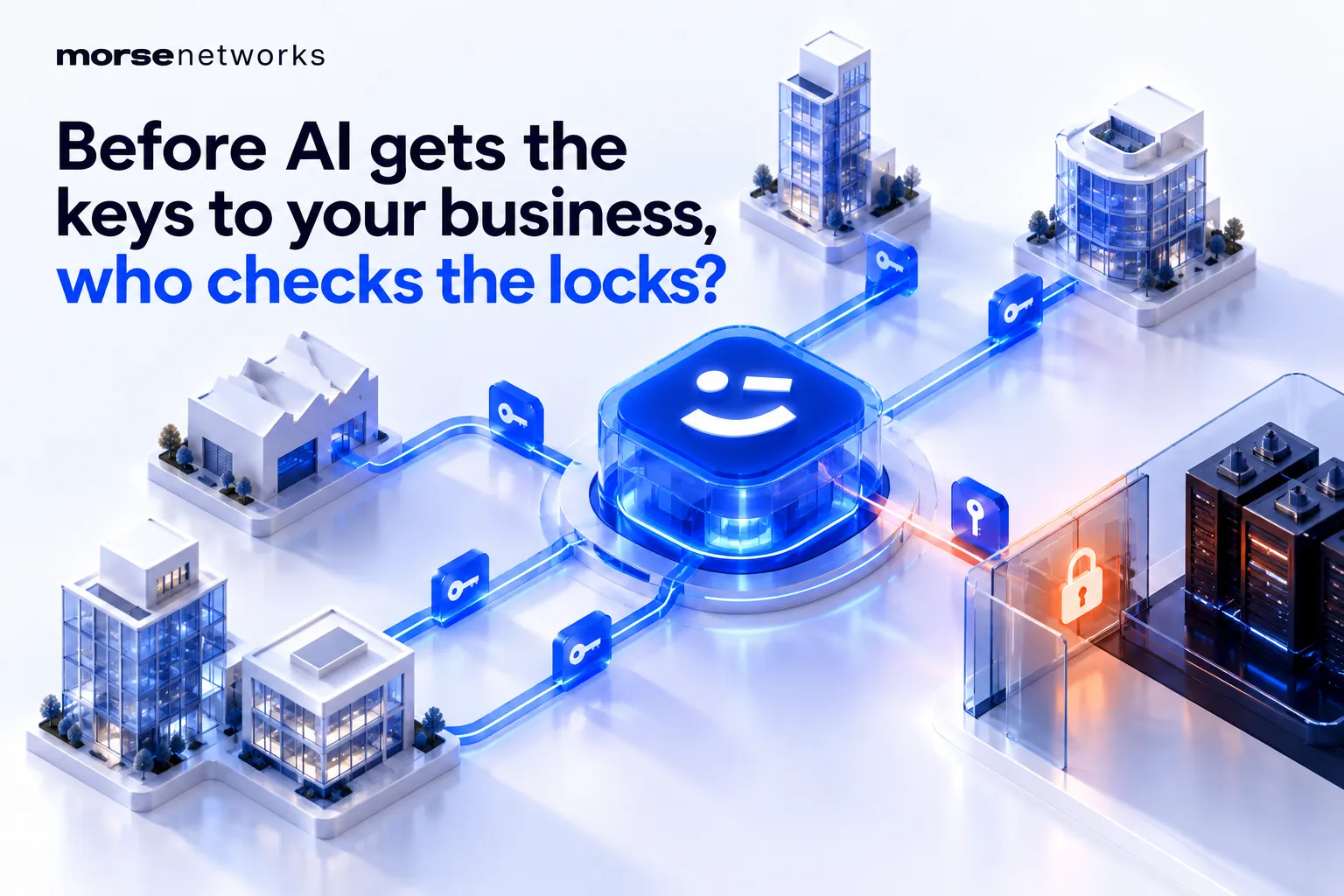

A clever system can still leave the door open.
That’s worth remembering when AI enters your business. It might draft emails, analyse reports or help manage support requests. Give it access to the wrong information, though, and a useful assistant becomes a security problem with excellent grammar.
Smart cities bring that challenge into sharp focus. Connecting transport, buildings and public services creates opportunities to work more efficiently. It also raises a question that applies just as readily to a UK business: who decides what each system can see, change and control?
The UAE’s announced AI-powered government cybersecurity collaboration offers a useful comparison, with code security, risk prioritisation and phased adoption in focus. The lesson isn’t that every business needs a smart-city command centre. It’s that security needs to be part of adoption, not something added once everyone’s impressed by the demonstration.
The office is a small connected city
Your business probably has more connected parts than you think. Email, accounting software, customer records, access controls, laptops and cloud storage all depend on identities, permissions and reliable information.
Add AI and those connections can become more consequential. A tool that summarises documents is one thing. A tool that can retrieve customer files, send messages or update records is quite another.
The difference is authority.
In a smart-city setting, you’d want clear controls around a system that influences public services. In your business, you should want equally clear controls around anything that touches payroll, contracts or customer information. Smaller scale doesn’t mean smaller responsibility.
Start with the job, not the technology
Before choosing an AI tool, write down the problem you want it to solve.
“Help staff find approved internal guidance” is a useful starting point. “Put AI into everything” is less useful. It’s also rather difficult to test.
Define what success looks like, which information the tool needs and what it must never do. Can it suggest an answer, or send one? Can it read a record, or change it? Does a person approve the result?
Those distinctions turn a vague ambition into a manageable project. They also make it easier to spot when a proposed integration asks for far more access than the job requires.
Check the locks before handing over access
AI doesn’t remove the need for basic security. It makes those basics more important.
Use named accounts where possible, require multi-factor authentication and give each user or integration only the permissions it needs. Review existing access before connecting a new tool. Old shared folders and forgotten administrator accounts don’t improve with age.
Check how the supplier handles your information. Where is it processed? How long is it retained? Can it be used to train models? Which settings control that use, and do they apply to the product or subscription you’re considering?
Avoid assuming that every AI service works the same way. Read the relevant terms and involve your IT and data protection advisers where needed. Customer information deserves more scrutiny than a request to tidy up a meeting agenda.
Treat code as code, whoever wrote it
AI-generated code can look convincing without being secure. The same applies to scripts, integrations and automated workflows.
If a developer or enthusiastic colleague uses AI to create something for your business, it still needs review and testing. Check how it handles passwords, validates inputs and deals with errors. Review any external software components it relies on, too.
Keep credentials out of code and use suitable tools to check for exposed secrets and known vulnerabilities. Test changes away from live systems before releasing them.
For AI tools that read emails, documents or websites, consider another risk: malicious instructions hidden inside that content. This is often called prompt injection. A system shouldn’t treat a sentence in an incoming document as permission to ignore its rules or reveal confidential information.
Put boundaries around what the tool can do, rather than relying entirely on what you’ve told it not to do.
Prioritise the risks that matter
Not every AI experiment needs the same level of control.
A tool rewriting a public event description presents a different risk from one handling employee records or changing payment details. Assess the sensitivity of the information, the actions available and the consequences of a mistake.
Start with three questions: what could be exposed, what could be changed, and who would be affected?
Then focus your attention accordingly. High-impact actions should have stronger controls, clear approval steps and useful audit records. There’s little comfort in a beautifully documented low-risk pilot if another department has quietly connected an unapproved tool to confidential files.
Give staff a clear route to request tools and report concerns. Otherwise, convenience tends to make the decisions.
Adopt in phases, with a working stop button
A sensible pilot has a limited purpose, a small group of users and a named owner. Use non-sensitive or suitably prepared test data where possible. Agree how you’ll measure usefulness, accuracy and security before you begin.
Keep human approval for consequential actions. Review errors as well as successful outputs. Check whether the tool performs reliably with awkward, incomplete or misleading information, not just the tidy examples used in a demonstration.
Only expand access when the evidence supports it.
You also need a way to stop. Know how to disable the integration, revoke its access and return to the previous process. If something goes wrong, the response shouldn’t begin with everyone searching for the person who set it up.
Keep someone accountable
AI can assist with security analysis and risk prioritisation, but it doesn’t take responsibility for your business decisions. Someone still needs to approve access, review alerts and decide when a risk is acceptable.
That’s the useful connection between smart cities and everyday business IT. Connected systems need clear ownership, controlled access and a practical plan for failure. Intelligence is helpful. Accountability is essential.
Before your next AI rollout, check the permissions, the data arrangements, the testing process and the exit route. None of it is especially glamorous. Neither is explaining why a tool had access to the entire customer folder.
If you’d like to talk through where AI fits into your business, and what needs checking first, talk to Morse Networks.