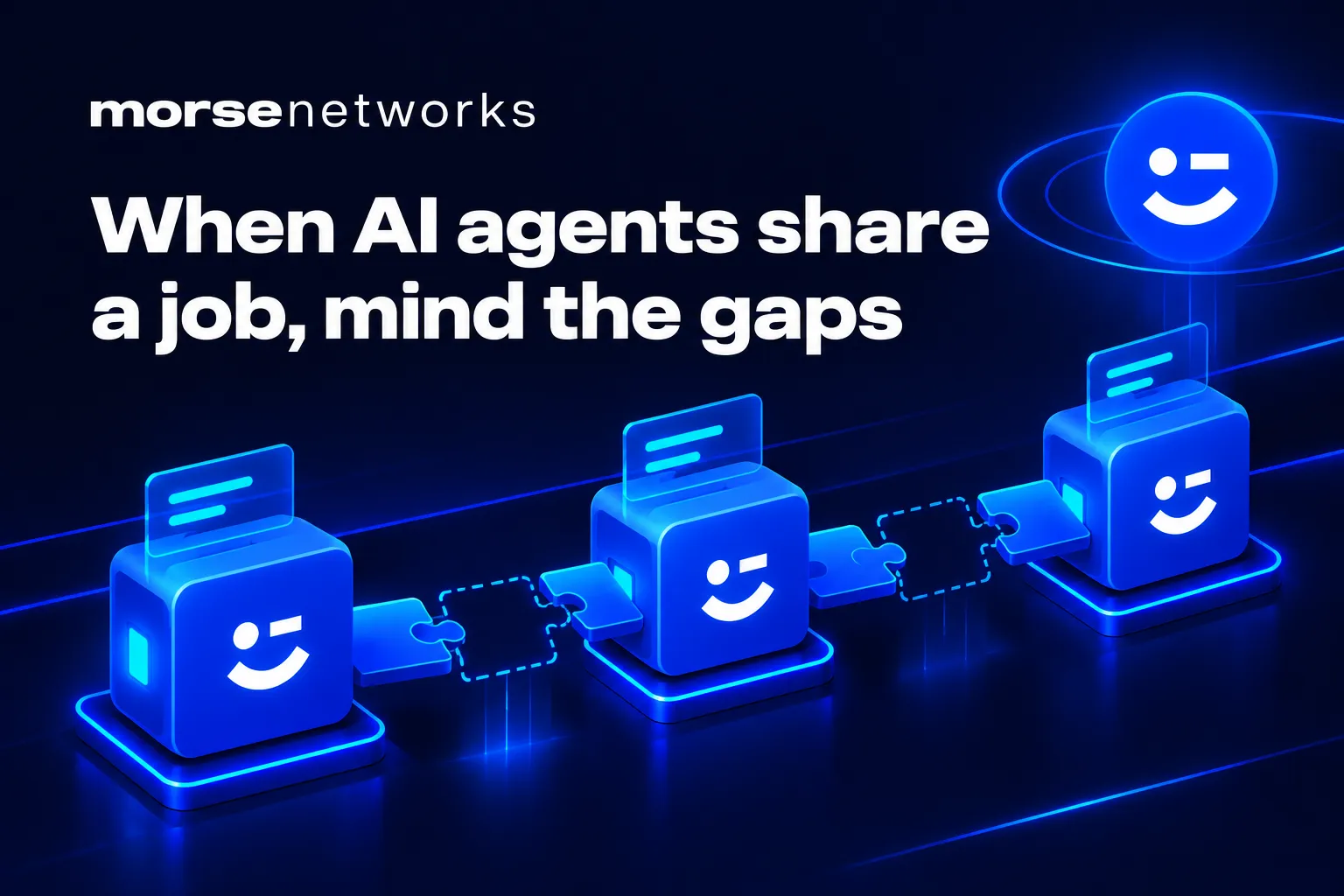

The invoice has been checked twice. The supplier is still waiting. Three AI agents are involved, and somehow the finance manager is doing the chasing.
That’s a workflow problem with some expensive new colleagues attached.
As businesses explore AI agents that can carry out tasks across software systems, the temptation is to give each one a job and let them get on with it. One reads incoming emails. Another checks records. A third prepares the response.
Each task sounds sensible. The awkward bit sits between them: deciding when work is ready to move, what information must travel with it and who steps in when something doesn’t add up.
Before adding another agent, it pays to sort out those handovers.
Start with a job that already causes friction
Choose a familiar business process where work passes between people or systems. Supplier invoice queries are a useful example.
An email arrives asking why an invoice hasn’t been paid. Someone finds the invoice, checks the purchase order and looks for evidence that the goods arrived. They may then need a budget holder to resolve a discrepancy before finance can reply.
An agent might help with parts of that process. Several agents might divide it between them. But automating an unclear process can move confusion around faster.
Map what happens now, including the unofficial steps. The spreadsheet on someone’s desktop counts. So does asking Janet, who remembers why that supplier has two account numbers.
Those details often explain where work gets stuck.
Give the whole job a human owner
A process needs someone responsible for the outcome, even when several agents handle individual steps.
For an invoice query, that might be the finance manager. Their responsibility is to ensure the query reaches a proper conclusion and that unresolved cases receive attention.
That doesn’t mean watching every action. It means having the authority and visibility to deal with problems.
Separate ownership of the process from responsibility for each task. An agent may retrieve the purchase order. A colleague may confirm delivery. Finance may authorise the response.
Write those responsibilities down in plain English. If the team can’t explain who owns an overdue query, adding more automation is unlikely to clarify matters.
Agree what a complete handover contains
“Invoice checked” is a poor handover. It leaves the next person or agent guessing what was checked and what remains uncertain.
A useful handover should carry the information needed for the next step. For an invoice query, that could include:
- The invoice reference and a link to the original document.
- The records checked, with any differences clearly marked.
- The next action required and the person or role responsible.
Keep facts separate from assumptions. “No delivery record found in the purchasing system” is useful. “Goods probably haven’t arrived” introduces a conclusion that the evidence may not support.
Agree on a consistent format, too. A receiving agent needs predictable fields and clear status labels. A human needs a summary they can understand without opening six applications and developing a personal grudge.
Make receipt part of the handover
Sending work onwards doesn’t prove it arrived somewhere useful.
An agent might finish its task and pass a query into a queue that nobody monitors. Another might reject the handover because a required reference is missing. Without a clear acknowledgement, the first agent could mark the work complete while the overall query remains untouched.
Define what successful receipt looks like. The receiving system should accept the task, record its new owner and make its status visible.
Also decide what happens if that acknowledgement never arrives. Set an appropriate waiting period, then route the problem to a named person or monitored queue.
This is the digital equivalent of making sure someone has actually taken the parcel before letting go.
Plan for the awkward cases first
Routine work makes an attractive demonstration. Exceptions reveal whether the process will survive a normal Tuesday.
Consider an invoice with a missing purchase order, a duplicate attachment or a supplier name that doesn’t quite match the account record. Decide where each case goes before agents start passing it around.
Give agents clear stopping rules. Missing evidence should trigger a defined exception route rather than repeated guessing or endless requests to another agent.
Set limits on retries and exchanges between agents. Otherwise, two systems can keep asking each other for information neither possesses.
Every exception needs an owner, a visible reason and a next step. A label saying “requires review” achieves little if nobody knows they’re doing the reviewing.
Keep shared systems from becoming a tug of war
Several agents may need access to the same inbox, customer record or ticket. That creates a practical risk: overlapping work.
Two agents could answer the same query. One could update a record while another is still working from an older version.
Decide which agent can change each part of the record and how work is reserved while it’s being handled. Before making an update, the system should check that relevant information hasn’t changed.
Keep an activity record showing what happened, when it happened and which agent or person was responsible. Use access permissions suited to each task, rather than giving every agent the same broad access.
These controls make mistakes easier to investigate and help prevent duplicate actions.
Test the journey, including the failures
A successful test should follow a piece of work from arrival to resolution.
Try incomplete information, an unavailable system, and a handover that gets rejected. Check whether a colleague can understand the current position and take over without reconstructing the entire history.
Measure outcomes that matter to the business. Look at unresolved queries, repeated work, and time spent correcting mistakes. A busy agent is only useful if the job moves forward accurately.
Start with a manageable workflow. Review the exceptions with the people who handle them, then adjust the process before extending it.
Put the handovers on the agenda
Before discussing how many agents your business needs, sketch one process and mark every point where responsibility changes hands.
For each handover, agree what must arrive, who accepts it and where problems go. That gives your team something concrete to assess before committing to more tools.
If you’re considering AI agents, talk to Morse Networks about the IT questions behind the workflow, including access, connected systems and keeping people in control.